
He confesses—
half sin, and half grace.
This is no rain at all: joy falls
by the fistful, in cascades of water—
let the conch of Panchajanya shatter
the monsoon of Asharh—
the mountain of love laughs in its ripened stream,
and Sucheta Sanyal returns
to the hidden exile of a silent sky.
The month of famine wanders, reckless,
over the drunken body
of Asharh—
while the waterfall keeps to its own course.
He confesses,
in a joy undone and scattered—
how the spellbound body comes to know
the soft rain-murmur of another body.
Sucheta Sanyal’s lips
fit flawlessly to the curve of his face—
to the madal’s drunken beat, the jasmine
tumbles on the wind across her back—
how many kisses cling to kisses
upon her back—
kisses by the thousand
for that hidden moon
of a sky set free of rain.
He confesses:
with a laughter, mahua-sweet, that could set stones afloat,
let her dance each night, let her dance,
Sucheta Sanyal—
in the breaking and the making of Jatin’s dreams.
The water of that monsoon lay
along the whole length of Sucheta Sanyal’s arms—
and Jatin stands astonished,
as though in the foothills, beneath a fierce Shraban.
And what has Jatin done
on the open plains of memory, far from his homeland—
who will count out his penance,
measure by measure,
for his half sin and his half grace—
Sucheta Sanyal, it is you, and only you,
who are the synonym of every forbidding.
10/5/2026
Poetry: Amitava Mukherjee
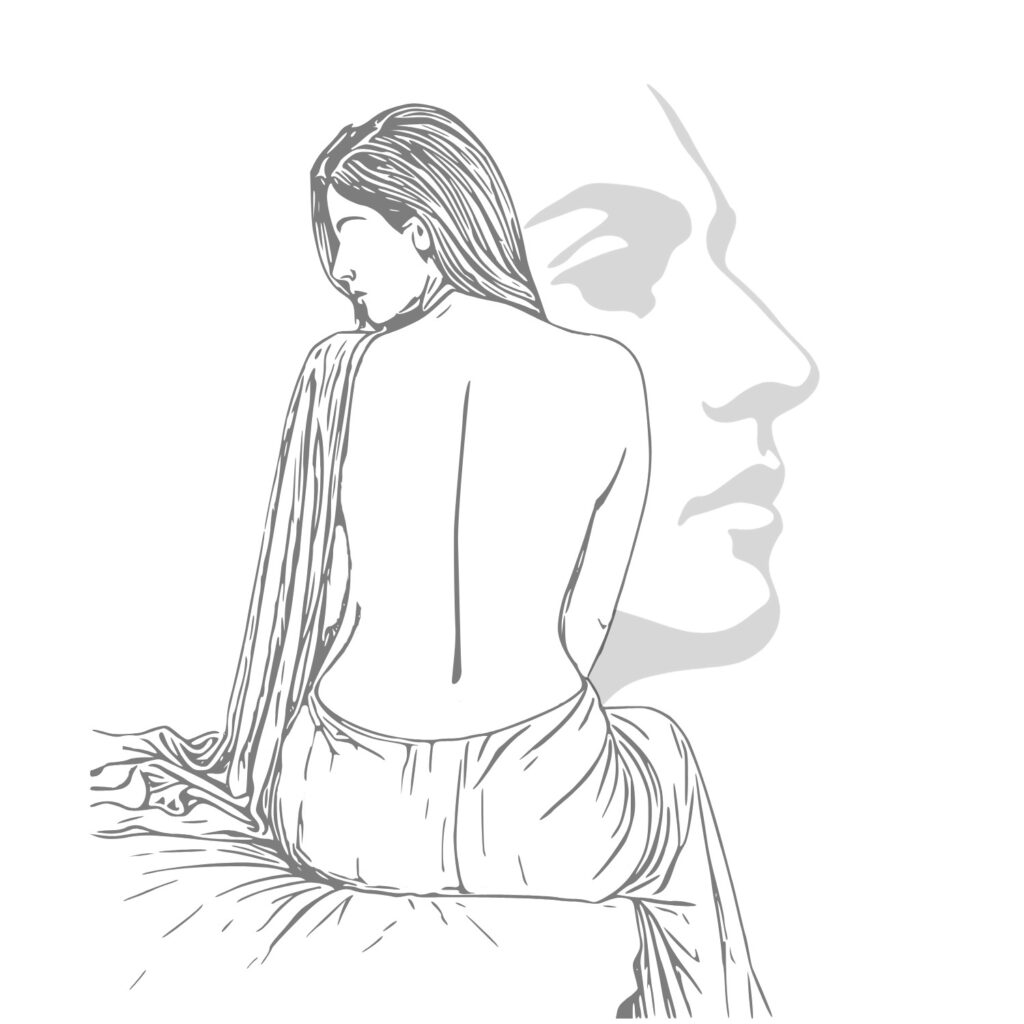
Illustration: Sumit Sanyal
Branding: Kaushik Bhattacharyya
Copyright © Amitava Mukherjee
Notes. Panchajanya is the sacred conch of Krishna, blown to herald battle in the Mahabharata. Asharh and Shraban are the two months of the Bengali monsoon. Ajnatabas, rendered here as “hidden exile,” recalls the Pandavas’ year of living in disguise. The madal is a tribal drum; mahua is a flower from which a heady country liquor is distilled.


No Comment! Be the first one.