
Writing in the Margins
Amitava Mukhopadhyay
A deconstructive reading of the movement after October 10
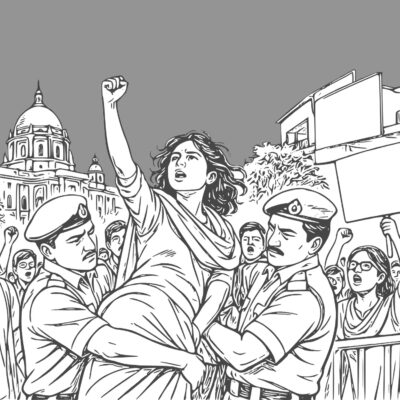
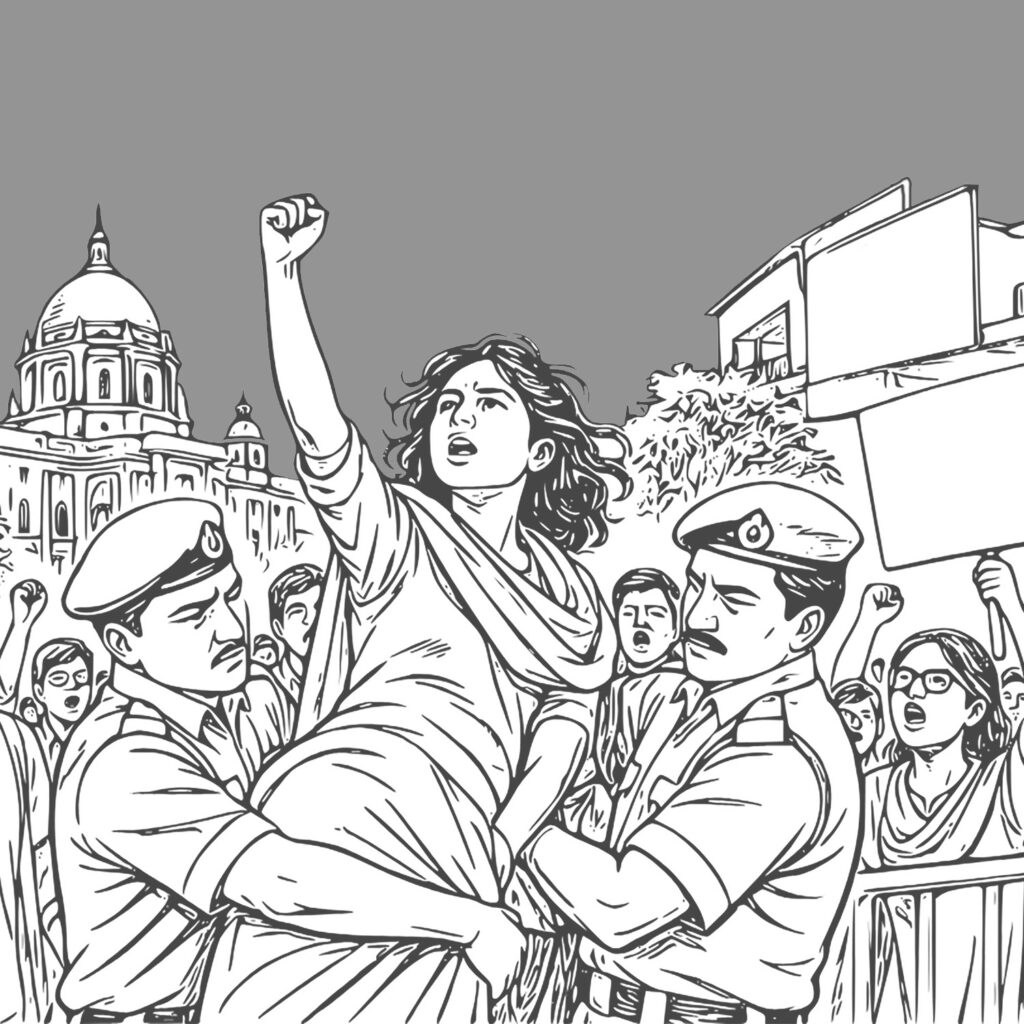
On October 10, the capital shut its gates — not against an invading army, but against its own citizens. Forty-five metro stations went dark. Mobile internet was cut within a few kilometres of the protest site. Hundreds of trains were cancelled, and around twenty-three thousand armed central police were deployed. By evening, officials put the number of detained at more than seven thousand: front-rank opposition leaders, lawyers who had walked over from the Supreme Court, journalists, and the national head of a left student organisation, picked up as she led students toward a place they had been told they could not reach.
The demands were plain enough. The Chief Election Commissioner should resign. The Special Intensive Revision of the electoral rolls should be paused. The rolls of January 2025 should be restored. And the 2023 law governing the appointment of election commissioners should be repealed. The answer was to turn a whole city into a fortress, in order to protect one institution of democracy from people who were asking for more democracy.
It is in that contradiction that a deconstructive reading begins.
Why deconstruction, why now
Jacques Derrida showed that every structure of meaning rests on paired opposites, and that one side of each pair quietly rules the other: writing over speech, the centre over the margin, order over disorder, the citizen over the outsider. Deconstruction is not demolition. It is reading so closely that you notice the hierarchy wobbling, and discover that the term dismissed as secondary was holding the whole structure up all along.
A protest is a text. So is the state’s reply to it. Read side by side, the events from July to October 10 say something hopeful.
In this reading, order is not the opposite of violence. On October 10 it was simply the name violence gave itself. A state that must seal its capital to defend “order” has already admitted that its order is fragile, and that the crack runs through its own foundation.
The leader who refuses to be the centre
Is the young student leader at the heart of these protests a genuine figure, or an image built by her own branding? The question already hides a binary: authentic leader versus manufactured icon. Deconstruction says the line was never clean. The real question is who holds the pen.
In her case, the institutions have mostly written against her. She was detained on September 25, and again on October 2. On October 4 she was picked up near the protest site and released hours later at a police station on the far edge of the city. Her organisation said her phone and bag were withheld; the police denied it. On October 10, her colleagues said, she was kept apart from the other detainees and denied access to lawyers.
And yet her own words that week pointed outward, never inward. At a joint press meeting she argued that student groups, opposition parties and civil society now stand on the same side, and she appealed directly to supporters of the ruling party to think again. On the day of the march she urged her generation to choose conscience over comfort. A conventional icon pulls meaning toward itself. This one sends it elsewhere: to students detained in Bihar, to job-seekers in Ranchi, to voters whose names have quietly vanished from the list. In Derrida’s terms she is less a centre than a trace, a mark that points toward what is absent. That is where her strength lies, and it is why the movement does not need her name to survive.
The voter list as an archive of power
In Archive Fever, Derrida argued that whoever controls the archive also controls what a society remembers.
The electoral roll is democracy’s most intimate archive, the written proof that a person is present in the republic. The revision exercise has turned it into a site of erasure. Data compiled by researchers in Kolkata and published with a gender-focused outlet suggests that around 62 per cent of those deleted or held under review in West Bengal are women, largely from constituencies with many Muslim, Scheduled Tribe and Matua residents. In Murshidabad alone, more than four and a half lakh names have gone. An analysis from Bihar found that Muslims, about 17 per cent of the population, made up roughly a quarter of those dropped from the draft rolls. In 45 constituencies in Uttarakhand, deletions exceeded the winning margin of the previous election.
Here Derrida’s idea of the supplement earns its keep. A document is meant to support a living citizen. In this exercise the supplement has replaced the person. The daughter who married into another village, the labourer who migrated for work, the old man whose papers were lost to a flood: all present in body, absent on paper, because paper now counts for more than people. Derrida coined the word différance for a meaning that never fully arrives and keeps being deferred. For these voters, what is being deferred is citizenship itself.
So the call to pause the revision and restore the earlier rolls is not a bureaucratic quibble. It is a demand to take the archive back from its gatekeepers.
Middle class or margin? Undoing a binary
Is this a movement of the middle class, or of the marginalised? The simple answer is that its visible face is young, educated and urban, while its deepest wounds are carried by the poor, by women and by minorities.
Deconstruction goes one step further and questions the split itself. For Derrida the margin is never simply outside the page; it is what gives the page its shape. The student whose entrance-exam paper leaked and the housewife in Murshidabad whose name was struck off are victims of the same collapsing archive, one of answer scripts, the other of voter rolls.
The sharpest example is the word that has become this youth wave’s name. In May, a remark from the bench compared some unemployed young people to cockroaches. Within a day, a young organiser turned the insult into the name of a party, and lakhs of young people followed. Derrida called this iterability: any sign can be lifted out of its original context and planted in a new one, where it gathers new meaning. A word of contempt became a badge of survival. The margin wrote back.
On October 10 the binary tottered once more. For a few hours, senior politicians, senior lawyers and journalists were treated exactly as ordinary protesters always are, herded onto the same buses as students and families and held without explanation. In that moment the line between centre and margin was not argued away. It was erased by experience.
Law, justice and a phantom crowd
In “Force of Law”, Derrida separated law from justice. Law can be written down and enforced. Justice cannot be fully captured by any rule, and it keeps calling the law to account. The bans, the refused permissions, the shuttered metro: in a narrow sense, all of it was lawful. The movement’s power lies in appealing past that lawfulness to a justice the law has not yet reached. The movement is asking for the law to be rewritten toward justice, not merely obeyed or defied.
The week also had a ghost. Before the march, claims spread online that five lakh, then ten lakh, counter-protesters were on their way. Derrida’s word for such a presence was hauntology: something spectral rather than real. The imagined crowd showed how absence itself can be turned into a weapon. Beside it, the movement’s own crowd, thousands of people detained and counted, became all the more real.
The democracy still to come
Can this movement genuinely carry opposition politics forward? A deconstructive reading gives an answer more patient than a simple yes, and more hopeful.
Derrida spoke of la démocratie à venir, the democracy to come. He meant that democracy is never fully present; there is always an unkept promise inside it, which someone has to keep claiming. These protests are where that claim is being made.
The movement has shown restraint: veteran activists appealed for peace at any cost, and organisers gave the police formal letters and written undertakings. It has shown continuity: when leaders were taken off a flight and detained, colleagues called supporters back to the protest site the very next morning. And it has built unity: parties that usually compete, and student groups that are often rivals, shared one pavement and one police bus.
Deconstruction carries a gentle warning too. A movement that overturns one hierarchy is always tempted to build a new centre and a new “them”. The instinct to speak to the ruling party’s supporters, rather than simply condemn them, is the right one. The movement’s strength will depend on keeping its borders open, so that the poorest housewife in Murshidabad, the job-seeker in Ranchi and the undecided voter in Lucknow can all find their erased names inside its demands.
Writing in the margins
Derrida’s best-known claim is that there is nothing outside the text. This year, for millions of Indians, that text was a voter list, and they discovered that they were the ones left outside it.
What the protesters are doing, on hunger strike, in police vans and on barricaded roads, is writing in that text’s margins. Such annotations cannot be wiped away. Every careful reader of democracy eventually turns to the margins, because that is where meaning is finally decided.
October 2026
Copyright: Amitava Mukhopadhyay
Illustration: Sumit Sanyal
Branding: Kaushik Bhattacharyya

No Comment! Be the first one.